DesignForge: Engineering Beauty at Scale
- Hal Wang
- January 3, 2026
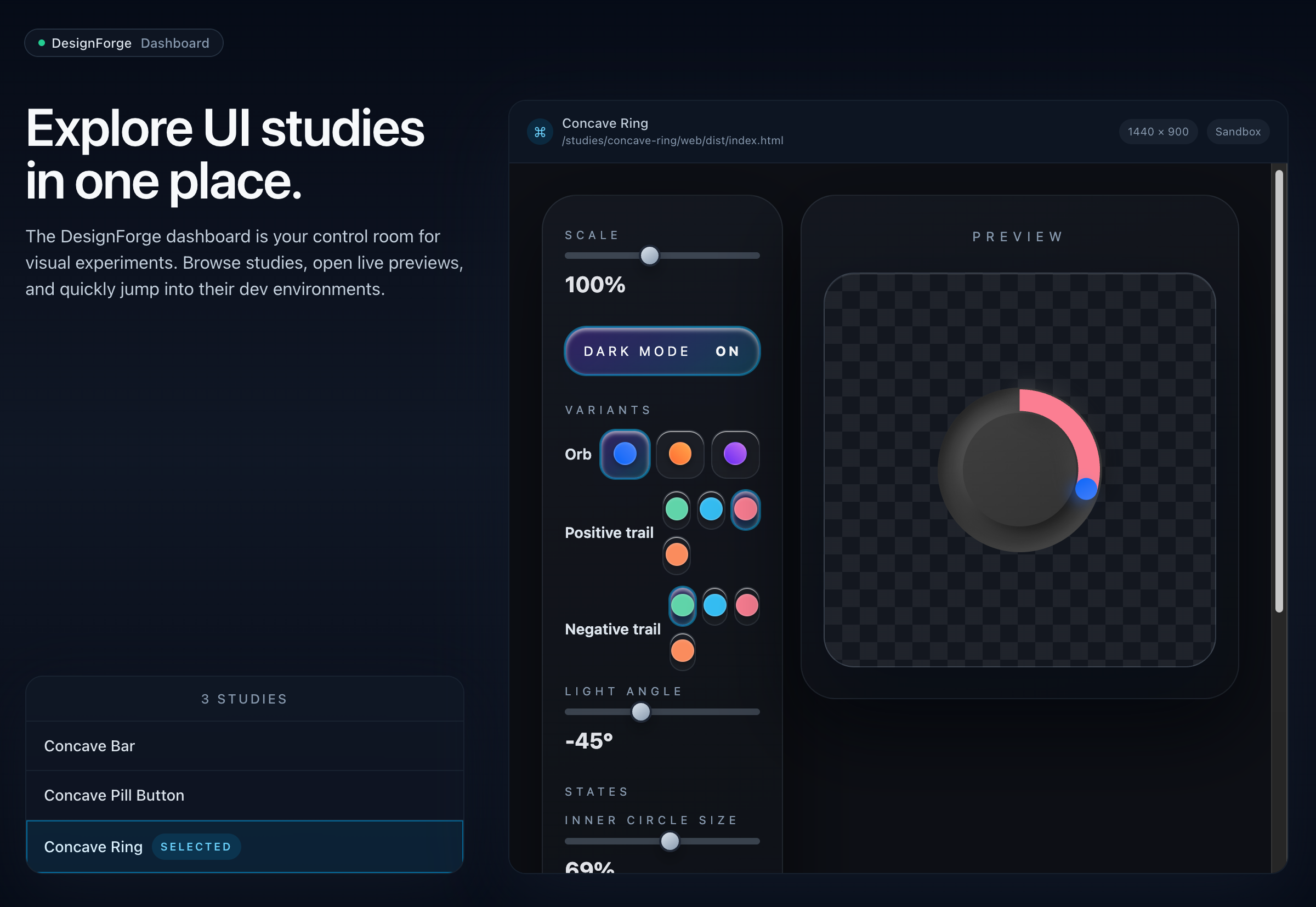
Table of Contents
Executive Summary
In the era of AI-assisted development, generating functional code has become trivial. However, bridging the gap between “functional” and “beautiful, production-grade” remains a significant challenge. DesignForge was created to address this specific need. It is not just a component library, but a design-quality repository—a curated collection of high-aesthetic UI exemplars, micro-interactions, and layout patterns designed to serve as style anchors for modern engineering teams across Web and SwiftUI.
The Challenge: Functionality vs. Aesthetics
Modern Large Language Models (LLMs) are exceptional at logic and structure but often struggle with the subtle nuances that make a user interface feel “premium.”
- Generic Designs: AI tends to default to safe, standard Bootstrap-like layouts.
- Inconsistent Visuals: Maintaining a cohesive style across disparate generated components is difficult.
- Lack of “Soul”: Subtle animations, precise spacing, and cohesive color theory are often lost in translation.
We needed a way to inject “soul” back into the development process—a source of truth that defines what good looks like so that both engineers and AI agents can replicate it.
The Solution: A “Design Forge”
DesignForge acts as a workshop for visual engineering. Instead of rigid, monolithic components, it provides studies—self-contained experiments in interaction and style. The project is dual-platform by design, supporting seamless style and design transfer between Web and SwiftUI. Because each study operates as an isolated small context, porting visual concepts across platforms becomes significantly easier.
“Think of it as a design forge—a workshop of crafted patterns ready to be reshaped into new creations.”
Key capabilities include:
- Polished UI Studies: Complete, high-fidelity implementations of complex UI concepts.
- Shared Workbench: A unified environment to develop, test, and showcase individual studies.
- AI-Ready References: Clean, semantic, and isolated code patterns that are easy for AI context windows to digest and adapt.
Technical Architecture
Built to scale, DesignForge leverages a modern monorepo structure to keep studies independent yet interconnected.
Monorepo Layout
The project is organized to separate concerns effectively:
web/: The top-level web portal for listing, previewing, and navigating all web components, including the shared workbench shell.studies/: A collection of isolated Vite apps. Each study is its own workspace, ensuring zero side-effects between experiments.mac/: A shared Swift package and workbench shell for macOS/iOS study projects.
Key Features
1. Isolated Workspaces
Each visual study runs in its own Vite sandbox. This encourages experimentation with heavy libraries or unique CSS approaches without bloating the main application bundle.
2. The Dual-Platform Workbench
The workbench acts as the common scaffolding for every study, standardized across both Web and macOS.
In the codebase, this is implemented via a shared WorkbenchShell component.
Key capabilities provided by the shell:
- Unified Theming: Automatically propagates light/dark mode and accent colors.
- Precision Scaling: On the web, it injects a
--df-scaleCSS variable to allow pixel-perfect zooming and inspection. - Layout Enforcement: Ensures a consistent 2 or 3-column layout (Control, Dissecting, Review) across all studies.
3. Rapid Scaffolding
Built-in tooling (npm run new-study) allows for the instant creation of new study environments, encouraging engineers to spin up a new “canvas” for every new idea, rather than hacking on existing code.
4. The “Forge” Workflow
Once study projects are refined, they can be “forged” into larger, reusable projects or widgets. A prime example is the bar wheel for the iOS app TempoBlocks, which began as an isolated study in this repository before being forged into a shipping feature.
Conclusion
DesignForge represents a shift in how we approach frontend engineering. By treating UI patterns as first-class citizens and providing a dedicated infrastructure for their development, we empower engineers to move beyond “good enough.” It is a testament to the belief that with the right tools, engineering and beauty are not mutually exclusive—they are complementary forces.